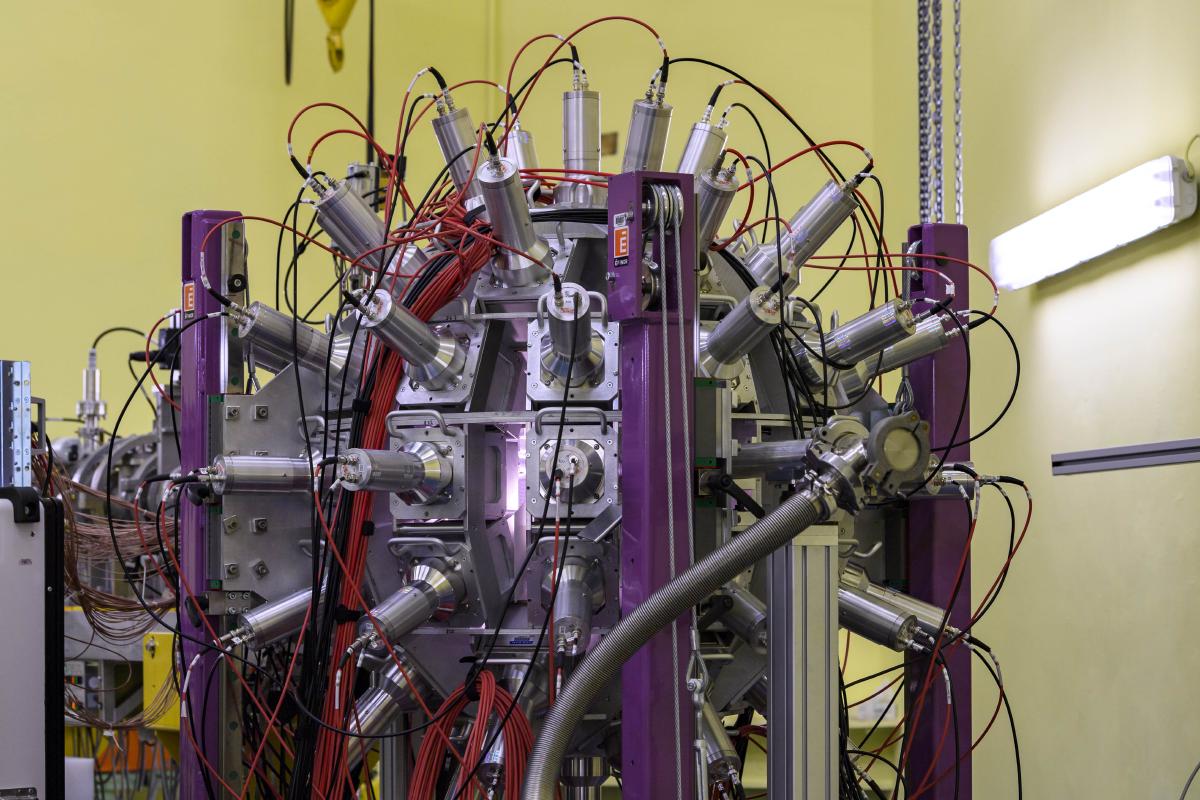
The detector SFyNCS is a device designed to study the radiative decay of nuclei formed during nuclear reactions. It consists of composed of 60 NaI(Tl) scintillators for the gamma-ray detection and double sided segmented Silicon detectors setup in a DE-E telescope for detecting light charged particles. We use the detector SFyNCS with a particle beam produced by a Tandem Van de Graaff accelerator. The (d,p) nuclear reaction is typically used, which is a transfer reaction that allows the transfer of the neutron from the incident deuteron. In such 2-body kinematics, the proton p, the ejectile of the reaction, is emitted at a precise angle and energy which can be measured by the telescope, making it possible to obtain the excitation energy left in the target nucleus. Then, the excited nucleus emits gamma-rays whose energies and multiplicity are measured by the NaI(Tl) scintillators. The informations obtained in coincidence event by event is analyzed using specific techniques to extract the desired physical quantities. These measured quantities can be then used to improve nuclear reaction models in order to calculate more accurately the cross-sections of the neutron radiative capture which is present in a wide range of contexts from stars to nuclear reactors.
This detector is described in more detail in the article published here https://doi.org/10.1016/j.nima.2025.170243