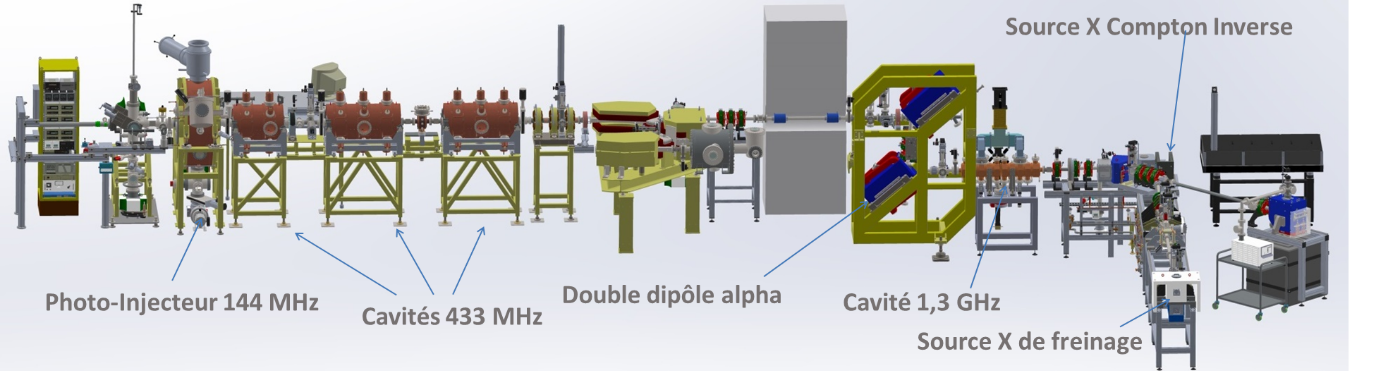
ELSA is a laser-driven radio-frequency linear electron accelerator: A short pulse laser illuminates a photocathode at a high repetition rate (72 MHz or 144 MHz), producing distinct electron bunches which are then accelerated by the alternating electric field in a microwave cavity (the photoinjector). The electron bunches, whose duration is short relative to the time period of the alternating field (typically 30 ps vs. 7 ns), are injected in the microwave cavity close to the maximum amplitude of the electric field. The micro-bunches are separated by time intervals of 7 or 14 ns, and are grouped by trains of 1 to 10 000 bunches. Each bunch carries a charge on the order of the nanocoulomb (nC) in ELSA typical use cases. While the typical kinetic energy of the electrons is 17 MeV, this parameter is also tunable. After their acceleration in 433 MHz microwave cavities (6 times the frequency of the 72 MHz cavity), the electrons go through a vertical compressor. The latter is composed of two magnetic dipoles named alpha dipoles after the similarity between the trajectory of the electrons and the Greek letter. An additional cavity may be used to increase the kinetic energy of electrons up to 30 MeV for some applications.
Two beamlines are used to generate X-rays for experimental teams. One beamline produces Bremsstrahlung radiation via the interaction of the electron beam with a tantalum target. The second beamline interacts with a laser beam and produces X-rays via inverse Compton scattering. While Bremsstrahlung produces a large bandwidth spectrum which spans from 0 et 17 MeV and peaks around 1 MeV, the X-ray spectrum produced by inverse Compton scattering is narrowband close to 10 keV for 17 MeV electrons and a green laser beam.
The X-rays generated by both beamlines are used to irradiate material samples or electrical components.