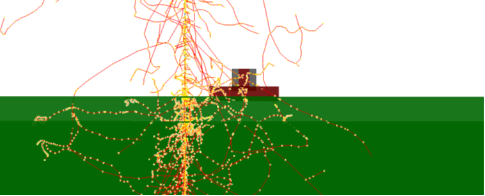
The LMCE focuses on simulating the effects of radiation on materials, particularly those used in electronics and optoelectronics. Microelectronic components operating in radiation-exposed environments, such as space or nuclear settings, are subjected to high levels of radiation. These radiation fluxes transfer their energy to the material they constitute, with two main consequences: the excitation of electrons and the displacement of atoms. In the context of constantly evolving microelectronics and optics technologies, it is important to understand these phenomena at the material scale. To do so, we can employ various methods. Radiation-matter interaction codes such as Geant4 are commonly used. Atomistic simulation methods at various scales, such as ab initio calculations based on density functional theory (DFT) and beyond, molecular dynamics—sometimes combined with machine learning approaches—and kinetic Monte Carlo simulations are also employed. This allows us to predict the energy deposition in materials due to irradiation, as well as the nature and structural and electronic properties of the defects generated. These studies are coupled with irradiation experiments on electronic and optical components and the associated dosimetry.
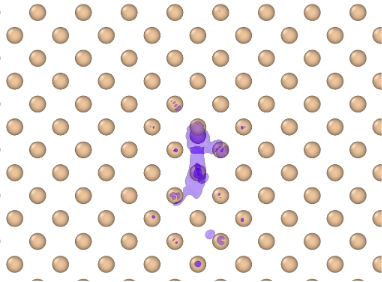
Figure 2:
Change in electron density as an ion passes through
Publications
- T. Jarrin, First-principles average electronic stopping power calculations: Trajectory selection based on electronic density, Phys. Rev. B 112, 245202 (2025) DOI
- D. Lambert, T. Jarrin, N. Richard, O. Duhamel, P. Paillet, Monte Carlo Simulations: From Neutron to Defects in Bulk Materials, IEEE Transactions On Nuclear Science 72, No. 8 pp.2519 (2025) DOI
- D. Lambert, S; Girard, G. Santin, M. Gaillardin, A. Morana, A. Meyer, J. Vidalot, J. Baggio, J. Mekki, H. Cintas, O. Duhamel, C. Marcandella, P. Paillet, Simulation-Assisted Methodology for the Design of Fiber-Based Dosimeters for a Variety of Radiation Environments, IEEE Transactions On Nuclear Science 71, no. 8, pp. 1846-1853, (2024)DOI
- D. Lambert, J. Parize, N. Richard, M. Raine, O. Duhamel, C. Marcandella, A. Losquin, A. Hemeryck, C.Inguimbert, P. Paillet, Neutron Displacement Damage Cross Section in GaN: Numerical Evaluations and Differences With Si, IEEE Transactions On Nuclear Science 70, No. 8 pp. 1870 (2023) DOI
- T. Jarrin, N. Richard, J. Teunissen, F. Da Pieve, A. Hémeryck, Integration of electronic effects into molecular dynamics simulations of collision cascades in silicon from first-principles calculations, Physical Review B 104, pp. 195203-1 – 195203-15 (2021) DOI
- G. Herrero-Saboya, L. Martin-Samos, A. Jay, A. Hemeryck, N. Richard, A comprehensive theoretical picture of E centers in silicon: From optical properties to vacancy-mediated dopant diffusion, Journal of Applied Physics 127, pp. 085703 (2020) DOI
- T. Jarrin, A. Jay, M. Raine, N. Mousseau, A. Hémeryck, N. Richard, Simulation of Single Particle Displacement Damage in Si1−xGex Alloys—Interaction of Primary Particles With the Material and Generation of the Damage Structure, IEEE Transactions on Nuclear Science 67, pp. 1273 – 1283 (2020) DOI
Researchers involved
T. Jarrin D. Lambert N. Richard